
Wood Species and Moisture: Choosing Millwork That Holds Its Line in the Carolinas

Trim splits, joints open, and painted panels telegraph their seams for one reason more often than any other: the wood arrived at a moisture content the house was never going to let it keep. In the Carolinas, where summer interiors sit humid and winter interiors run dry under gas heat, that gap is the single largest driver of millwork callbacks. This paper covers how species selection and moisture control work together on high-end residential work.
Wood moves, and it moves in one direction more than the others
Timber is dimensionally stable along its length and restless across its width. A 6-inch-wide flat casing can move a sixteenth of an inch across the face through a seasonal cycle while its length stays essentially fixed. That is why long runs rarely fail in the middle and almost always fail at the joint, and why wide flat stock — panel stiles, apron boards, wide base — demands more care than a narrow profiled stick.
Two numbers matter more than any species chart:
- Equilibrium moisture content (EMC) — the moisture the wood will settle to in the conditions where it lives. Conditioned interiors across the Carolinas typically land between 7 and 9 percent.
- Delivered moisture content — what the material actually reads when it arrives. Kiln-dried interior trim should read 6 to 8 percent. Material at 12 percent will shrink after installation, and no joinery detail survives that.
Species selection, read as engineering rather than taste
Poplar is the workhorse of painted millwork: stable, closed-grained, takes a crisp profile, and accepts primer beautifully. It is soft, so it belongs on cornices, panel work, and casings rather than on stair skirts or door edges that take abuse.
Finger-jointed pine is the most stable paint-grade substrate available, because the finger joints interrupt continuous grain. It is excellent for long straight runs and poor anywhere an edge will be exposed to moisture.
White oak is the current standard for stain-grade interiors — hard, dense, and, when rift or quarter-sawn, notably stable across its width. Plain-sawn oak is less expensive and moves more; on wide panel components, that difference shows.
Mahogany and Spanish cedar hold their dimension well and resist rot, which makes them the honest choice for exterior casings, brick moulds, and anything on a porch.
Walnut and cherry are chosen for color and figure. Both are stable enough for interior work; both change tone with light exposure, and clients should be shown a sample that has been aged rather than a fresh one.
Acclimation is a schedule item, not a courtesy
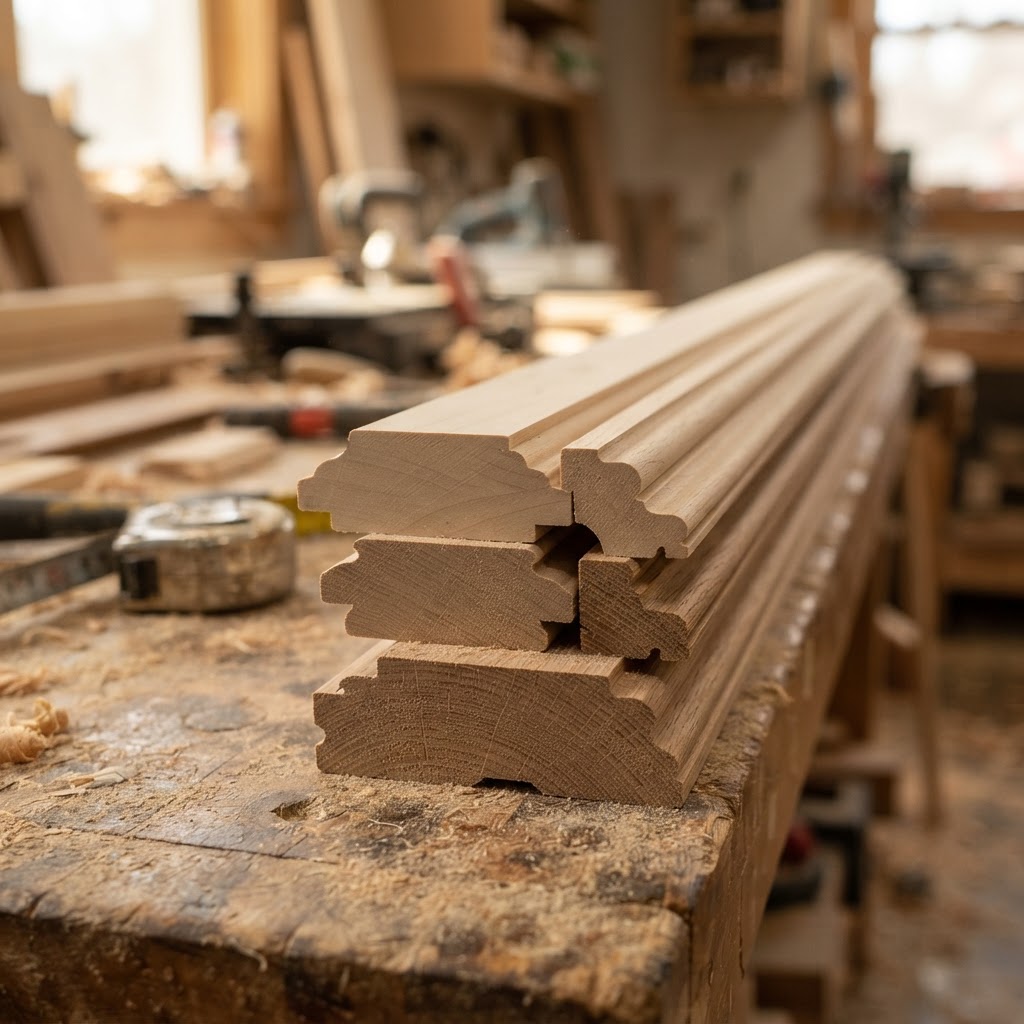
Material should sit in the conditioned space where it will be installed, stacked flat on stickers with air moving around it, for five to seven days before installation. That single line in the schedule prevents more callbacks than any joinery detail. Three conditions make it non-negotiable:
- HVAC is running and holding the design set point — not "the building is dried in."
- Wet trades are finished. Fresh plaster, drywall mud, and concrete all release water into the air for weeks.
- The material is off the slab and out of the garage. A garage in August in Monroe is a humidor.
Detailing for the movement you cannot eliminate
- Let panels float. A raised or flat panel is captured, never glued, in its stiles and rails.
- Prime all six sides. Back-priming is not optional on wide paint-grade stock; a sealed back face keeps the board from taking on moisture from one side and cupping.
- Seal end grain everywhere, and especially on exterior work, where end grain wicks water an order of magnitude faster than face grain.
- Choose scarf joints over butt joints on long runs — a scarf that opens slightly reads as a shadow, while a butt joint that opens reads as a defect.
- Glue miters, and pin them. An unglued outside corner will open the first winter.
- Hold trim off masonry and off the slab with a sealed shim, not a caulk bead.
A short pre-installation checklist
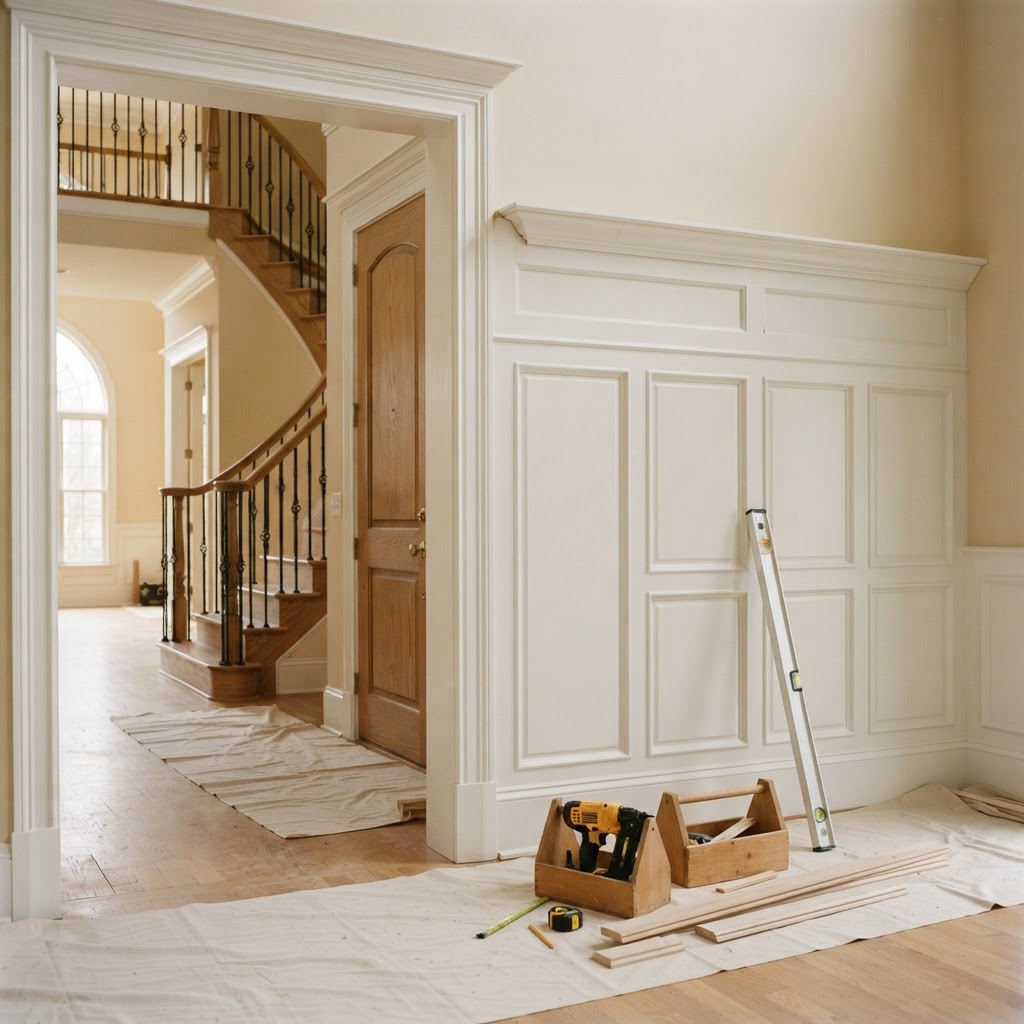
Before the first stick is cut: HVAC running at set point; wet trades complete; a moisture meter reading of 6 to 8 percent on random pieces from each bundle; material stacked flat and stickered in the room for at least five days; paint-grade stock back-primed; species and finish confirmed against the approved sample.
None of it is exotic. All of it is cheaper than pulling a paneled dining room apart in February.
How we handle it
Ellis-Reid runs its interior stock to 6 to 8 percent, bundles by stock length so material is not cut down before it needs to be, and publishes species availability profile by profile so paint-grade and stain-grade decisions can be made in the drawing set rather than on the jobsite. For projects in the Carolinas we are glad to review a millwork schedule for moisture and movement risk before it goes out to bid.
Ellis-Reid Millwork + Specialties · Monroe, NC.
Profiles mentioned in this article
Or browse the complete trim library of 500+ CAD-drawn profiles.